Affiliate disclosure: This research-based guide contains Amazon affiliate links. HappyPetJourney may earn from qualifying purchases at no extra cost to you.
Evidence label: Research-based. We compared published capacities, shapes, materials, cleaning instructions, and the problems owners repeatedly report. We did not time meals with these bowls ourselves.
Quick answer
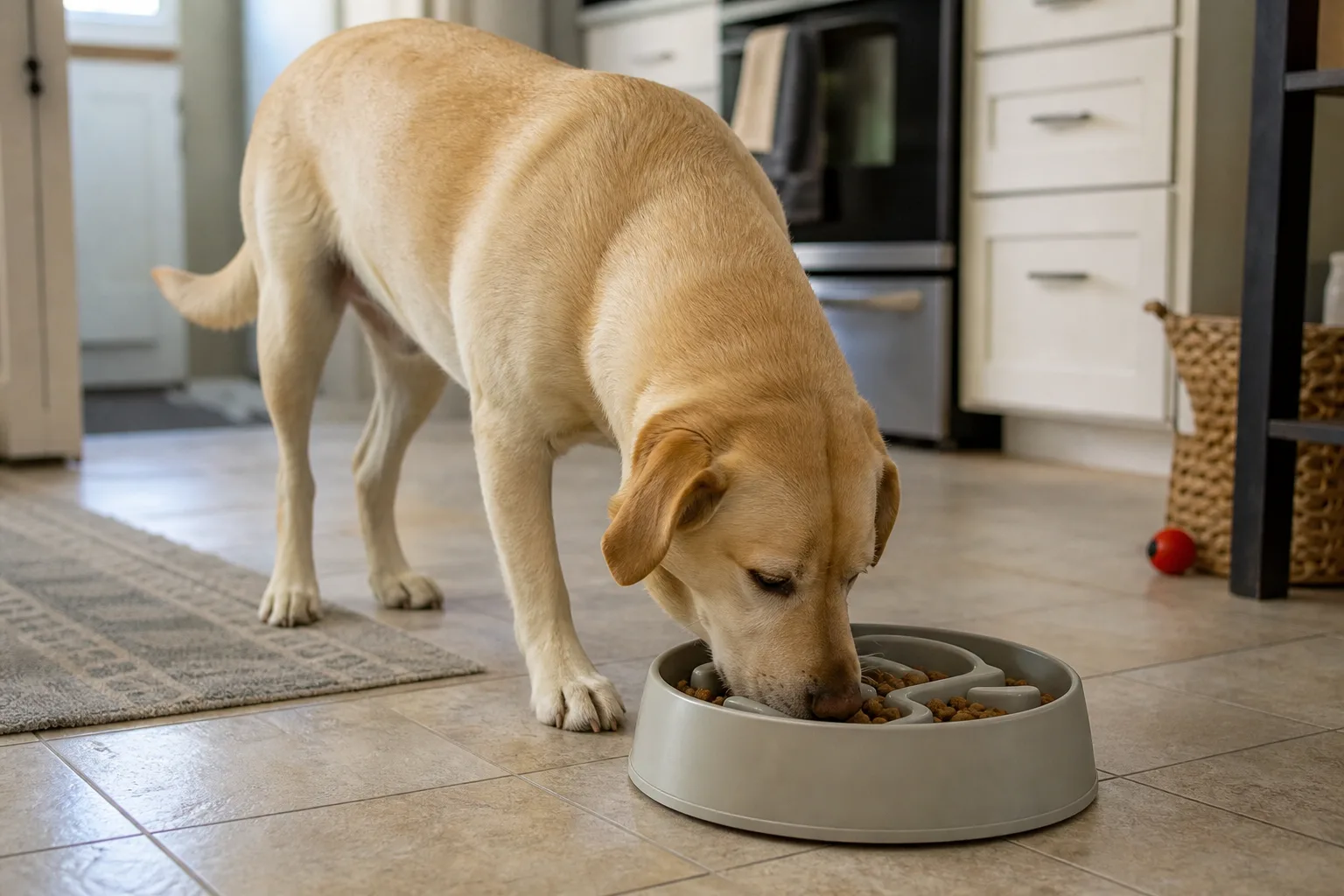
For a large dog that empties a normal bowl in seconds, start with a wide, non-slip slow feeder that holds the dog’s actual meal without piling kibble above the ridges. Outward Hound’s large Fun Feeder is the simplest first comparison for dry or wet food. A stainless insert is easier to sanitize and harder to chew. A wobble or lick-style feeder is better for soft food and enrichment, but it is not the best unsupervised choice for a powerful chewer.
What we checked
- usable meal capacity rather than the word “large”
- ridge depth and whether a broad muzzle can reach the food
- base width, grip, and resistance to tipping
- dishwasher instructions and hard-to-clean corners
- material and the risk of chewing or swallowing damaged pieces
Choose by the problem at your house
| What happens now | Better starting point | Common mismatch |
|---|---|---|
| Kibble disappears in under a minute | Wide maze bowl with moderate ridges | A tiny bowl that makes the meal frustrating rather than slower |
| The bowl slides across tile | Heavy base, rubber grip, or a fitted non-slip mat | Adding more complicated ridges without fixing movement |
| The dog chews plastic after eating | Stainless slow-feeder insert; remove it after the meal | Leaving a flexible feeder down as a chew toy |
| Most meals are canned, raw, or soaked | Shallow lick or wobble feeder used under supervision | Deep narrow channels that retain food and are difficult to wash |
Quick pick
Outward Hound Fun Feeder Slo Bowl, Large
Match the exact large size and maze pattern. Amazon may group several capacities and colors on one listing.
First, check whether speed is the only problem
Fast eating is common, but a bowl should not be used to explain away repeated vomiting, weight loss, pain, a swollen abdomen, or unsuccessful retching. Those signs need veterinary advice. Gastric dilatation-volvulus (bloat) is an emergency, particularly in large, deep-chested dogs. A slow feeder can change the pace of a meal; it cannot guarantee prevention of bloat or treat a medical condition.
The practical test is simple: measure one normal serving before shopping. If the dog eats three cups, a bowl advertised for “large dogs” but usable only with two level cups is already the wrong product. Food heaped above the maze turns the slow feeder back into a normal bowl for the first half of dinner.
Three useful starting points
These are different formats for different dogs. The first item is not automatically the right choice for every home.
Outward Hound Fun Feeder Slo Bowl, Large
Before clicking: Match the exact large size and maze pattern. Amazon may group several capacities and colors on one listing.
- Best for: large dogs eating dry or wet food too quickly
- Why it stands out: the maker lists a three-cup capacity, a 9.8-inch footprint, non-slip base, and top-rack dishwasher cleaning
- Main compromise: plastic is a poor fit for a dog that chews the bowl after meals
The moderate maze is a sensible place to begin because it slows access without requiring a long, narrow muzzle. Watch the first meal. The dog should work around the ridges, not scrape its nose repeatedly, flip the bowl, or walk away frustrated.
Skip it if: a normal serving is larger than its usable capacity, the dog has a very broad or short muzzle, or plastic chewing is already a habit.
Check the large Fun Feeder on AmazonSpecification source: Outward Hound.
Stainless Steel Slow-Feeder Insert
Before clicking: Measure the inside diameter and depth of the existing bowl. Confirm the insert cannot lift out or expose a chewable edge during use.
- Best for: homes that already use a stable stainless bowl
- Why it stands out: less plastic contact and generally simpler cleaning
- Main compromise: fit varies widely, and a loose insert can become another object to pick up
An insert is useful when the current bowl already has the right capacity and base. Prefer a simple raised center or broad obstacles over a dense pattern with tight seams. Remove and inspect it after every meal during the first week.
Skip it if: the product does not publish dimensions, the dog can pull it free, or the combined bowl develops gaps that trap food.
Compare stainless slow-feeder inserts on AmazonLickiMat Wobble
Before clicking: Confirm the current dimensions and material instructions. Treat it as a supervised feeding tool, not a chew toy.
- Best for: spreading canned food, soaked kibble, or a small portion of a dog’s meal
- Why it stands out: licking plus movement creates a different challenge from a fixed maze
- Main compromise: the published 6.5-inch footprint is not a full-meal solution for every large dog
This format makes most sense when the goal is to extend a soft-food portion or add structured indoor enrichment. It is less convincing as the only bowl for a large dog eating a high-volume meal.
Skip it if: the dog bites flexible feeders, needs an unsupervised meal, or becomes more frantic when the bowl moves.
Check LickiMat Wobble options on AmazonSpecification source: LickiMat.
A seven-day bowl test that tells you more than star ratings
- Day one: time the current meal once without changing the portion.
- Days two and three: supervise from a distance. Look for nose rubbing, pawing, flipping, or gulping food gathered at one edge.
- Day four: wash the bowl exactly as the label directs. Check whether food remains in seams or under removable parts.
- Days five to seven: decide whether the pace is calmer and repeatable. A longer meal is not a win if the dog is distressed or cannot reach a meaningful part of the food.
Keep the packaging until you know the capacity, shape, and cleaning routine work in your home. If the first maze is too difficult, a simpler obstacle or several small portions can be more useful than buying an even more complicated bowl.
Bloat warning: a suddenly enlarged abdomen, repeated unsuccessful retching, restlessness, weakness, or collapse requires emergency veterinary care. Do not wait to see whether a feeding accessory helps.
Last checked: July 27, 2026. Product capacities, materials, sellers, and listing variations can change; verify the current listing before ordering.