Free dog crate size calculator
What Size Crate Does My Dog Need?
Enter your dog's measurements to calculate the minimum interior length, width, and height, then compare 12 verified crate models with clear FIT, BORDERLINE, or NO FIT reasons.
Why interior dimensions matter: two 42-inch crates can provide different usable space. This tool checks your dog's required room against manufacturer-sourced interior measurements, not the size label alone.
- No sign-up
- Manufacturer-sourced dimensions
- Home, vehicle, and air-cargo modes
Step 1
Enter your dog's measurements
Open the full A–D measurement diagram
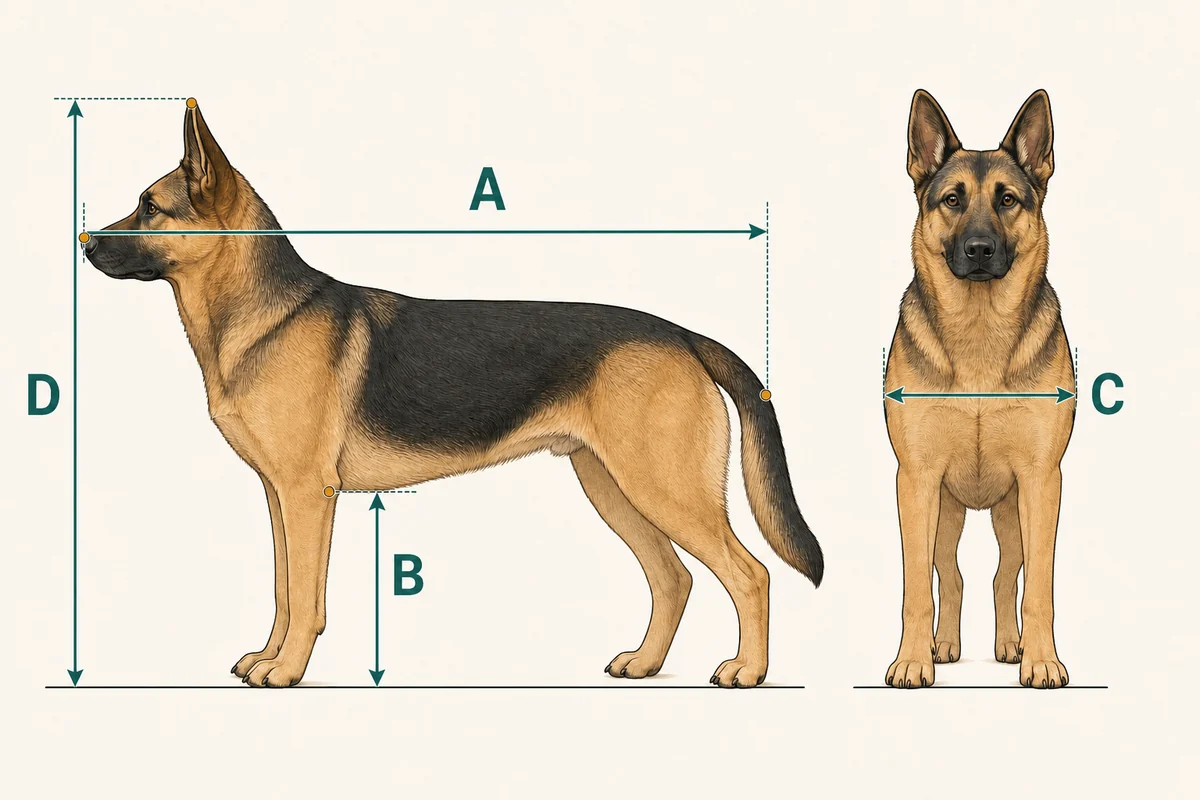
How to measure
Four measurements prevent most sizing mistakes
- Length (A): measure from the nose tip to the base of the tail—not the tail tip.
- Elbow height (B): measure from the floor to the elbow joint. Air-cargo mode uses half of this value as added length.
- Shoulder width (C): measure the widest point across the shoulders.
- Standing height (D): measure to the top of the head or ear tip, whichever is higher.
Verified model database
Compare real interior dimensions
These are manufacturer-sourced dimensions, not generic size-class estimates. Evidence A means the maker lists the interior measurements directly; Evidence B means they were calculated from an explicit manufacturer dimension policy.
Revol Medium
Collapsible home crate
31.4 × 20.6 × 21.5 in interior Verified 2026-08-16Revol Intermediate
Collapsible home crate
38.8 × 25 × 28 in interior Verified 2026-08-16Revol Large
Collapsible home crate
42.5 × 28 × 30 in interior Verified 2026-08-16G1 Small
Double-wall travel kennel
21.75 × 14.5 × 15.5 in interior Verified 2026-08-20G1 Medium
Double-wall travel kennel
25 × 18 × 19.75 in interior Verified 2026-08-20G1 Intermediate
Double-wall travel kennel
30 × 18 × 25 in interior Verified 2026-08-16G1 Large
Double-wall travel kennel
33.25 × 21 × 29 in interior Verified 2026-08-16Collapsible 34 Intermediate
Collapsible aluminum crate
34 × 22.5 × 28.5 in interior Verified 2026-08-16Collapsible 40+ XL
Collapsible aluminum crate
40 × 26.5 × 32.5 in interior Verified 2026-08-16Airline 400 Series Large
Molded airline travel kennel
32 × 21 × 25 in interior Verified 2026-08-20Airline 500 Series Extra Large
Molded airline travel kennel
36 × 23 × 28 in interior Verified 2026-08-20Original Kennebec
One-piece travel kennel
31.8 × 20.4 × 22.25 in interior Verified 2026-08-16Dimensions and product configurations can change. Recheck the linked manufacturer page before purchase. Air results are never treated as final airline approval.
Worked example: why the crate label can give the wrong answer
For home mode, take a dog measuring 30 inches from nose to tail base, 24 inches to the highest head or ear point, and 10 inches across the shoulders. This calculator adds 4 inches to length and height, and doubles measured shoulder width. The planning result is 34 × 20 × 28 inches of minimum interior space.
The 4 inch allowance is this tool’s home-planning assumption, not a universal product standard. Measure the individual dog and check that it can stand, turn and rest naturally. If shoulder width is omitted, the tool estimates width from length; measuring width gives a stronger comparison.
Compare every interior dimension
For the 34 × 20 × 28 inch example, the records below illustrate why a longer exterior size does not necessarily solve a height problem. These are dimensional comparisons from the existing manufacturer-source dataset, not new hands-on tests.
| Model | Listed interior L × W × H | Dimensional result | Source |
|---|---|---|---|
| Diggs Revol Medium | 31.4 × 20.6 × 21.5 in | Does not meet example: length and height | Manufacturer reference |
| Diggs Revol Intermediate | 38.8 × 25 × 28 in | Borderline clearance: height only meets the minimum; remeasure before choosing | Manufacturer reference |
| Diggs Revol Large | 42.5 × 28 × 30 in | Clears the example dimensions; confirm use, support and capacity separately | Manufacturer reference |
| RuffLand Airline 400 Series Large | 32 × 21 × 25 in | Does not meet example: length and height | Manufacturer reference |
Home, vehicle and air-cargo results differ
Using those same 30 inch body and 24 inch height measurements, vehicle mode adds 2 inches instead of 4: 32 × 20 × 26 inches. It also requires a separate check of the vehicle opening, exterior crate size and restraint arrangement. A dimensional match is not a crash-performance certification.
Air-cargo mode uses a different calculation: body length plus half elbow height, twice shoulder width, and standing height plus the bedding thickness entered. Confirm the individual animal, crate and route with the operating airline. Home-mode clearance cannot establish airline acceptance.
Load this home-size example into the calculator or compare apartment space and crate placement.
Quick size reference
What size dog crate do I need?
Measure first whenever possible. Weight and breed charts are only starting points because two dogs at the same weight can have different body length, shoulder width, and standing height.
| Common crate class | Typical maximum interior target | Use this row only when |
|---|---|---|
| 30-inch | Up to about 30 × 19 × 21 in | All three calculated minimum dimensions fit. |
| 36-inch | Up to about 36 × 23 × 25 in | The dog can stand, turn, and lie naturally. |
| 42-inch | Up to about 42 × 28 × 31 in | The listed interior—not exterior—dimensions clear the result. |
| 48-inch | Up to about 48 × 30 × 33 in | Width and height fit as well as body length. |
| 54-inch or custom | Compare exact manufacturer dimensions | A standard class does not clear every minimum. |
Example: a 70 lb dog does not automatically need one fixed crate size. Enter body length and standing height above, then use weight only to verify the product's capacity.
Breed starting points
Dog crate size by breed
Breed can narrow the shopping range, but it cannot confirm fit. The ranges below reuse the site's sourced dog-size records; measure your individual dog and compare all three required interior dimensions before buying.
| Breed or variety | Common crate class to compare | Measurement most likely to change the answer |
|---|---|---|
| Labrador Retriever | 36–42 inch | Body length or standing height |
| Golden Retriever | 36–42 inch | Standing height; do not count coat volume as body size |
| German Shepherd Dog | 42–48 inch | Standing height and ear clearance |
| Standard Poodle | 36–42 inch | Standing height |
| Rottweiler | 42–48 inch | Usable interior width and product capacity |
| French Bulldog | 24–30 inch | Shoulder width; airline rules require a separate check |
| Standard Dachshund | 24–30 inch | Nose-to-tail-base length |
| Beagle, 13–15 inch variety | 30–36 inch | Body length |
Need an adult-size estimate for a growing dog? Use the Puppy Weight Calculator and breed-size database, then return here with expected adult measurements.
Weight-based questions
Dog crate size by weight: 50, 70 and 90 lb starting points
Weight is useful for checking a crate's structural capacity, not for proving physical fit. These ranges are deliberately broad so a tall, long, or wide dog is not forced into a weight-only answer.
What size crate for a 50 lb dog?
Compare the 30- and 36-inch classes first. A tall or long 50 lb dog may need the larger class; measured interior length, width, and height decide.
What size crate for a 70 lb dog?
Compare the 36- and 42-inch classes first. Many Labradors, Golden Retrievers, and similarly sized dogs sit near this boundary.
What size crate for a 90 lb dog?
Compare the 42- and 48-inch classes first. Standing height is often the limiting dimension for tall dogs.
Size comparison
36 vs 42 inch dog crate: which one fits?
Choose the smallest model whose published interior dimensions clear every calculated minimum. Move from a 36-inch to a 42-inch class when length, height, or width fails—not simply because the dog reaches a particular weight.
| Check | 36-inch class | 42-inch class |
|---|---|---|
| Typical listed size | About 36 × 23 × 25 in | About 42 × 28 × 31 in |
| Use when | Every calculated minimum fits with practical clearance | The 36-inch model fails length, width, or standing-height clearance |
| Puppy planning | Buy for expected adult measurements and use a secure manufacturer-approved divider. | |
Method and sources
What the calculator does
Home and vehicle modes add practical clearance to the measured body dimensions, then choose the smallest common crate class whose typical dimensions clear the result. Product dimensions vary, so the class is only a shopping filter.
Air-cargo mode uses IATA's published minimum internal-dimension method: length = A + ½B, width = 2C, and height = D plus the bedding thickness you enter. Snub-nosed dogs receive a 10% size increase. Airlines and destinations may impose stricter rules.
Read IATA Traveler's Pet Corner · 2026 IATA Container Requirement 1
Dog crate size calculator FAQ
How do I calculate what size crate my dog needs?
Measure nose to tail base, floor to the highest point of the head or ears, and shoulder width. Add practical clearance, then choose a crate whose listed interior length, width, and height all meet the calculated minimums.
Should I choose a crate by weight?
No. Weight helps check product capacity, but body length, standing height, and shoulder width determine whether the dog can stand, turn, and lie naturally.
What size crate does a 70 lb dog need?
There is no reliable size from weight alone. Many dogs around 70 lb fall near common 36- or 42-inch classes, but the correct answer depends on measured body length, standing height, and shoulder width.
What size crate for a Labrador or Golden Retriever?
A 36- to 42-inch class is a common comparison range for adult Labradors and Golden Retrievers. Measure the individual dog because a longer or taller dog may need the next class.
What size crate for a German Shepherd?
Compare 42- and 48-inch classes, then use standing height and ear clearance to decide. Vehicle setups also need the exterior crate height checked against the cargo opening.
Should I choose a 36 or 42 inch dog crate?
Choose the smallest exact model whose listed interior length, width, and height clear the calculator result. Move to 42 inches when a 36-inch model fails any one of those dimensions.
What if my puppy is still growing?
Size for the expected adult measurements and use a secure divider to reduce usable space during crate training.
Can I use this result to book a flight?
No. Air-cargo mode is a planning estimate based on IATA's measurement formula. Confirm the exact container, breed, route, and documentation rules with every operating airline before purchase or travel.
Are all 42-inch crates the same size?
No. The label normally describes a size class. Interior width and height vary by manufacturer, door design, wall taper, and construction.
Next: check the car opening
Once the interior suits your dog, compare the crate exterior with your cargo area and hatch using the crate car fit checker. For walking gear, match measurements in the harness size calculator.
Practical decision guide · Reviewed October 5, 2026
Turn a crate size result into a purchase decision
A nominal 36-inch or 42-inch class is a search starting point. Compare the actual interior, the dog’s measurements and the intended use before treating any model as a fit.
Separate three sets of dimensions
| Measurement | What it answers | What it does not answer |
|---|---|---|
| Dog body dimensions | How much internal space to compare | Whether the assembled crate fits in a car |
| Published interior L × W × H | How much space is inside the model | Whether every corner, door or bedding setup is usable |
| Assembled exterior L × W × H | Fit in the home, cargo area and opening | Comfort or adequate restraint |
Keep a model’s exterior and interior in separate columns. Never substitute shipping-box dimensions or a rounded size-class label. If the source does not publish the interior, ask for it rather than estimating wall thickness from a photograph.
Read dimensional margins, not only a pass label
Suppose your planning minimum is 34 × 20 × 28 inches of interior. A hypothetical crate with a 35 × 21 × 28.25-inch interior clears those minima by 1, 1 and 0.25 inches. Height is the weakest margin, even though every central value passes. A repeat dog-height reading just half an inch higher would erase that nominal height margin.
Measure again when a result is close. Check whether manufacturer dimensions refer to the narrowest usable area, and whether feet, tapered walls, door hardware or a removable tray affect it. These details are separate from the tool’s calculation. Rounding a centimetre value to a whole inch can hide a small mismatch.
Bedding and accessories occupy the interior
A two-inch mat reduces usable standing height by approximately two inches if the dog stands on it at that thickness. This does not mean every mat has that effective thickness: measure the actual occupied setup. A fixed water bowl, divider or other accessory can reduce usable floor space or turning room.
For a puppy, evaluate the divider’s current usable area and its adjustment range. An adult size estimate cannot confirm that today’s partition fits. Recheck body dimensions during growth and after changing the bedding or accessories.
The intended use can change the recommendation
Home accommodation, a vehicle travel kennel and air-cargo carriage are different use cases. This tool’s planning allowances help compare dimensions; they do not establish a manufacturer’s transport recommendation. GUNNER, for example, distinguishes travel sizing in its own sizing guidance. Use the exact model’s instructions rather than applying a home-space rule to every travel product.
For air travel, get the operating carrier’s current acceptance requirements for the route, aircraft and exact crate configuration before buying. A model name containing “airline” or a dimensional pass is insufficient. The tool’s air mode is planning information, not carrier approval.
A before-checkout decision sequence
- Repeat the dog measurements and choose the intended use.
- Compare all three published interior dimensions and inspect the smallest margin.
- Account for the real bedding and accessories.
- Measure the assembled exterior and door clearance in the intended location.
- Confirm the manufacturer’s use, divider and restraint instructions.
Use the vehicle and hatch checker for the exterior step. The puppy growth estimate can inform a purchase plan, but actual body measurements decide current crate fit.
Sources and scope
Numerical examples describe the stated geometry or this tool’s documented assumptions. Manufacturer instructions apply to the exact named products. Source review does not imply physical product testing.